
On George Cruikshank
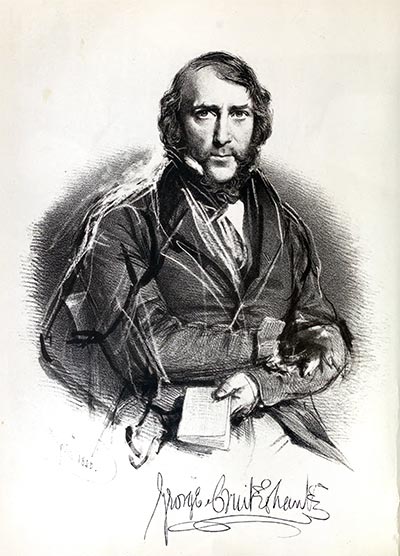
George Cruikshank's special merit (I set aside all his other merits, such as expressive finesse and subtle understanding of the fantastique[1] ) is an inexhaustible abundance in the grotesque. This verve is unimaginable, and would be considered impossible if there weren't evidence of it in the form of a vast body of work, a countless collection of vignettes, a long series of comic albums, and ultimately, such a quantity of characters, situations, physiognomies, and grotesque scenes that the observer's memory gets lost; the grotesque flows incessantly and inevitably from Cruikshank's pen, just as rich rhymes flow from the pens of natural poets. The grotesque is his habit.
If one could confidently analyze something as fleeting and intangible as sentiment in art, that certain something that always distinguishes one artist from another, no matter how closely related they may appear, I would say that what primarily constitutes Cruikshank's grotesque is the extravagant violence of gesture and movement, and the explosion of expressive energy. All his little characters perform with fury and turbulence, like actors in a pantomime. The only fault one might reproach in him is to be often a man of wit and a caricaturist more than an artist, and not always to draw with sufficient diligence and care.
It seems that, in the pleasure he takes in surrendering himself to his prodigious verve, the artist forgets to endow his characters with sufficient vitality. He draws a little too much like like men of letters who enjoy scribbling sketches. These spellbinding little creatures are not always viable from birth. All this tiny crowd tumbles, bustles about and mingles with indescribable vivacity, without worrying too much about limbs not being in quite their natural place. Too often, they are just human hypotheses struggling as best they can. In any case, such as he is, Cruikshank is an artist gifted with rich comedic talents, who will remain in every collections.
Translation by OBI
This article is based on a passage from Curiosités esthétiques: Salon 1845-1859 by Charles Baudelaire, published in Paris by Michel Lévy Frères, 1868.
-
- ^ Le fantastique is a genre which overlaps with horror and fantasy. It was more precisely defined by critic Tzvetan Todorov (1939-2017) as distinguished by its deliberate ambiguity regarding the supernatural. Authors often associated with the genre include E. T. A. Hoffmann, E. A. Poe, and Mary Shelley.
- Image source: The Internet Archive